Welcome & Overview
Welcome to the Inaugural Meeting and Workshop of the J-PARC K10 Collaboration. This milestone event officially launches a pioneering experimental program at the frontiers of hadron physics.
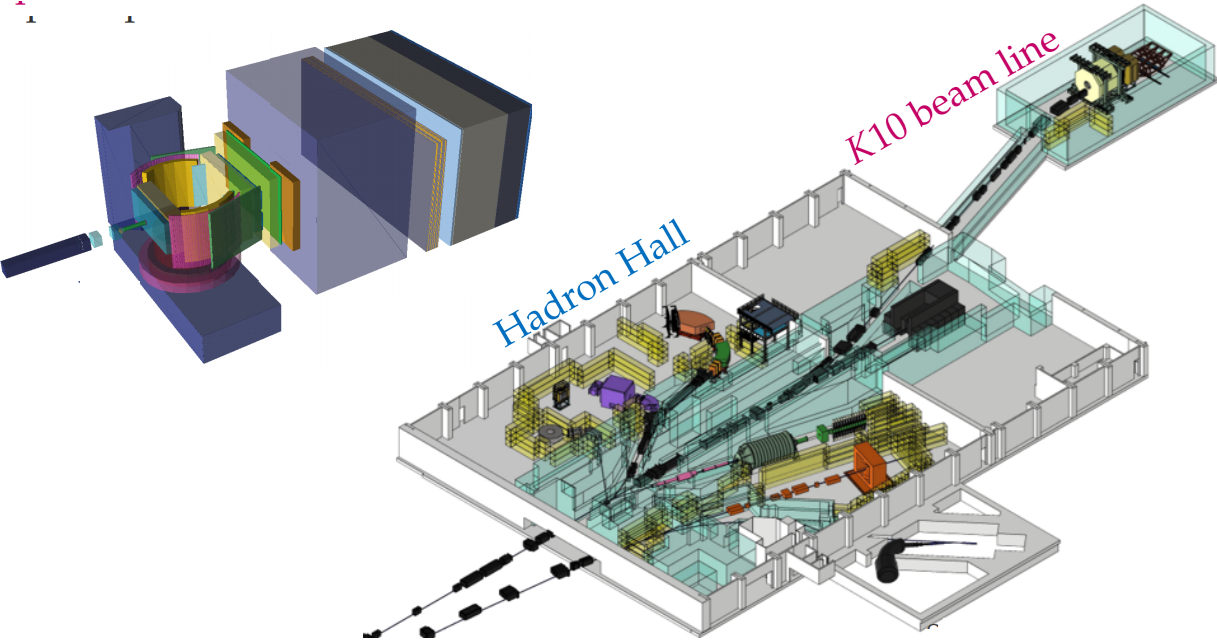
The J-PARC K10 initiative introduces a state-of-the-art RF-separated secondary beamline capable of delivering high-intensity, high-purity kaon, pion, and antiproton beams up to 10 GeV/c. To maximize the physics potential of these extraordinary beams, the collaboration is designing a next-generation superconducting dipole spectrometer. This detector system features a vast geometric acceptance engineered to detect and reconstruct multi-particle final states with unprecedented efficiency and precision.
Operating at the critical transition zone where non-perturbative QCD shifts into perturbative dynamics, the K10 experiment occupies a unique niche that complementary facilities like Belle-II, LHC, and the Electron-Ion Collider (EIC) cannot access. By exploring rich physics programs including Hadron Spectroscopy, Hunting for Exotic States, and Time-like Generalized Parton Distributions (GPDs), the K10 Collaboration seeks to unravel the core mechanisms of QCD color confinement and the emergence of hadronic mass.
This workshop will bring together world-leading theorists and experimentalists to establish the collaboration’s governance, refine the detector conceptual designs, and consolidate our roadmap toward the upcoming ICC and KEK proposals. We warmly invite you to join us in shaping the future of hadron physics.
Online Participation
Participants joining remotely can access the meeting via Zoom:
Join Zoom Meeting
Scientific Objectives & Scope
-
Beamline Technology: Up to 10 GeV/c RF-separated secondary beam transport design, focusing on K/pi separation optics with potential extension up to 15 GeV/c.
-
Detector Systems: Large-aperture superconducting dipole magnet and high-granularity tracking/PID subsystems for multi-particle final states.
-
Physics Program:
-
Hadron Spectroscopy & Exotic states (multiquark systems, charm/strange baryons).
-
Transition from non-perturbative to perturbative QCD (Confinement mechanism).
-
Time-like Generalized Parton Distributions (GPDs) probing the internal structure of hadrons.
-
Sponsors