1st J-PARC K10 Collaboration Meeting & Workshop on K10 Physics and Detector Technology

→ Asia/Seoul
Multimedia Room, Hana-Square (Korea University)

Multimedia Room, Hana-Square

Korea University

1. Entering the Campus / Hana Square: * Head toward the Science Campus area (near Anam Station Exit 4). * Locate Hana Square, the underground campus complex situated between the Science Library and the science buildings. * Go down the outdoor grand staircase or use the glass-cube entrance leading directly into Hana Square from ground level. 2. Finding the Location on B1 Floor: * Once you enter, take the elevator or stairs down to the 1st basement floor (B1F). * Follow the signs toward the student welfare zone. * Walk past the bank and the central courtyard (sunken garden), and you will find the Multimedia Room at the very end of the hallway.
Description

Welcome & Overview

Welcome to the Inaugural Meeting and Workshop of the J-PARC K10 Collaboration. This milestone event officially launches a pioneering experimental program at the frontiers of hadron physics.

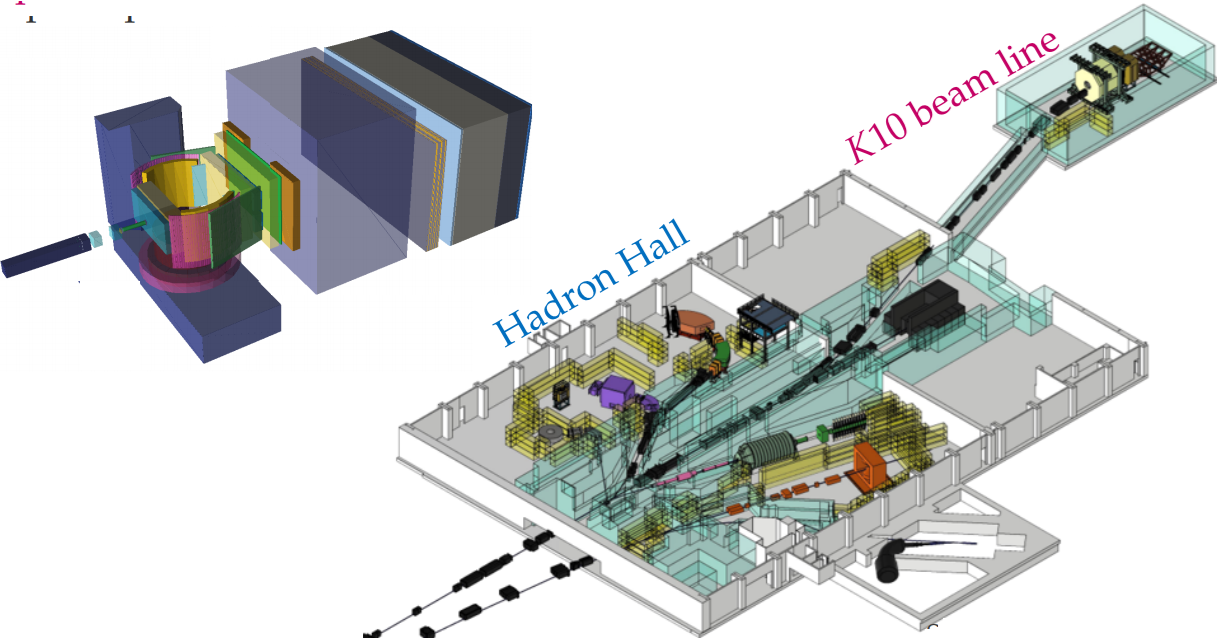
The J-PARC K10 initiative introduces a state-of-the-art RF-separated secondary beamline capable of delivering high-intensity, high-purity kaon, pion, and antiproton beams up to 10 GeV/c. To maximize the physics potential of these extraordinary beams, the collaboration is designing a next-generation superconducting dipole spectrometer. This detector system features a vast geometric acceptance engineered to detect and reconstruct multi-particle final states with unprecedented efficiency and precision.

Operating at the critical transition zone where non-perturbative QCD shifts into perturbative dynamics, the K10 experiment occupies a unique niche that complementary facilities like Belle-II, LHC, and the Electron-Ion Collider (EIC) cannot access. By exploring rich physics programs including Hadron Spectroscopy, Hunting for Exotic States, and Time-like Generalized Parton Distributions (GPDs), the K10 Collaboration seeks to unravel the core mechanisms of QCD color confinement and the emergence of hadronic mass.

This workshop will bring together world-leading theorists and experimentalists to establish the collaboration’s governance, refine the detector conceptual designs, and consolidate our roadmap toward the upcoming ICC and KEK proposals. We warmly invite you to join us in shaping the future of hadron physics.

Online Participation

Participants joining remotely can access the meeting via Zoom:
Join Zoom Meeting

Scientific Objectives & Scope

  • Beamline Technology: Up to 10 GeV/c RF-separated secondary beam transport design, focusing on K/pi separation optics with potential extension up to 15 GeV/c.

  • Detector Systems: Large-aperture superconducting dipole magnet and high-granularity tracking/PID subsystems for multi-particle final states.

  • Physics Program:

    • Hadron Spectroscopy & Exotic states (multiquark systems, charm/strange baryons).

    • Transition from non-perturbative to perturbative QCD (Confinement mechanism).

    • Time-like Generalized Parton Distributions (GPDs) probing the internal structure of hadrons.

 

Sponsors

Korea University Sejong UniversityKEKJPARCRCNP

Registration
Registration
Participants
    • 09:00 → 09:25
      Registration
    • 09:25 → 09:45
      K10 Collaboration Meeting Overview
      Convener: Jung Keun Ahn (Korea University)
      • 09:25
        Opening Address (K10/K-GENESIS/K-DREAMS) 5m
        Speaker: Jung Keun Ahn (Korea University)
      • 09:30
        Congratualatory Address 5m
        Speaker: Naohito Saito (KEK)
      • 09:35
        Congratulatory Address 5m
        Speaker: Seung-il Nam (Pukyong National University)
      • 09:40
        Congartulatory Address 5m
        Speaker: Un-Ki Yang (Seoul National University)
    • 09:45 → 11:00
      Physics Overview
      Convener: Myung-Ki Cheon (Soongsil University)
      • 09:45
        Overview of K10 Physics 30m
        Speaker: Makoto Takizawa
      • 10:15
        Structrure of Hadrons with K10 25m
        Speaker: Yongsun Kim (Sejong)
      • 10:40
        Exploring Hadron Interactions and Gluonic Dynamics with Kaon and Antiproton Beams 20m
        Speaker: Takatsugu Ishikawa (RCNP/The University of Osaka)
    • 11:00 → 11:15
      Coffee Break and Group Photo 15m
    • 11:15 → 12:15
      K10 Beamline Design
      Convener: Jung Keun Ahn (Korea University)
      • 11:15
        Overview of the J-PARC K10 Beamline 15m
        Speaker: Hitoshi Takahashi (KEK)
      • 11:30
        Optimization of the K10 Beamline 15m
        Speaker: Ji Kwang Hwang (Kangwon National University)
      • 11:45
        Design and Fabrication of the K10 Beamline and Spectrometer Magnets (KR-Tech) 15m
        Speaker: Jong Mo Hwang (PLS)
      • 12:00
        Fabrication of a Superconducting 9-cell Cavity 15m
        Speaker: Jun Ho Han (KAT)
    • 12:15 → 13:30
      Lunch Break 1h 15m
    • 13:30 → 15:00
      Detector Technology
      Convener: Hiroyuki Noumi (RCNP/The University of Osaka)
      • 13:30
        Overview of the K10 Spectrometer 30m
        Speaker: Kotaro Shirotori (RCNP/The University of Osaka)
      • 14:00
        ALICE Silicon Detector for the K10 15m
        Speaker: Min Jung Kweon (Inha University)
      • 14:15
        CMS MIP Timing Detector for the K10 15m
        Speaker: Jae Hyeok Yoo (Korea University)
      • 14:30
        EIC GEM Tracker for the K10 15m
        Speaker: In-Seok Yoon (Seoul National University)
      • 14:45
        Discussions for the K10 Detector (KDREAMS) 15m
    • 15:00 → 15:15
      Coffee Break 15m
    • 15:15 → 17:30
      Collaboration Business Meeting

      Charter discussion, Management board setup, roadmap to ICC/KEK proposals

      Convener: Shinya Sawada (KEK)
      • 15:15
        Opening Address 5m
        Speaker: Shinya Sawada (KEK)
      • 15:20
        Approval of the K10 Charter (Bylaws) 20m
      • 15:40
        Approval of the K10 Collaboration Membership 15m
      • 15:55
        Nomination and Approval of Spokesperson and Co-Spokesperson 20m
      • 16:15
        Nomination and Approval of Management Board Members 25m
      • 16:40
        Discussion on Future Acitivities in Each Division 20m
      • 17:00
        Discussion on the K10 Yellow Report 15m
      • 17:15
        Action Items and Next Steps for Our ICC and KEK Proposals 15m
    • 17:30 → 17:40
      Break 10m
    • 17:40 → 18:20
      Special Seminar on Nuclear Astrophysics
      Convener: Baha Ballantelin (Wisconsin)
      • 17:40
        Nuclear Astrophysics with Neutrinos 40m
        Speaker: Baha Ballantelin (Wisconsin)
    • 18:20 → 18:30
      Closing
      • 18:20
        Closing Address 10m
    • 19:00 → 21:00
      Collaboration Dinner 2h